The Operating System for Industrial Companies
Field ops. Compliance. Reporting. Sales. Leadership. All in one place.
Where Is Your Operation Breaking Down?
Disconnected Software
Your CRM doesn’t talk to your field system.
Your field system doesn’t talk to accounting.
Your reporting lives in spreadsheets.
Data is scattered across tools that were never designed to work together.
You’re operating with fragments instead of a system.
Manual Approvals Slowing Everything Down
Pump authorizations.
Equipment releases.
Purchase approvals.
Change orders.
Everything waits on emails, phone calls, or someone remembering to follow up.
Speed kills in industrial.
Manual workflows kill speed.
Paper in the Field
Clipboards.
Handwritten tickets.
Lost documentation.
Delayed data entry.
By the time information reaches leadership, it’s already outdated.
Field execution should be real-time, not retroactive.
Leadership Reacting Instead of Directing
You don’t see problems until they hit revenue.
You don’t know numbers until month-end.
You don’t know bottlenecks until someone complains.
Instead of commanding the operation, you’re constantly responding to it.
That’s not leadership.
That’s firefighting.
No Real-Time Visibility Into Operations
You can’t answer simple questions instantly:
What jobs are behind?
What equipment is idle?
What approvals are pending?
Where are we bleeding margin?
You wait for reports.
You wait for someone to check.
You wait for the month to close.
By the time you see the issue, it’s already cost you.
Growth Is Creating More Chaos, Not More Control
Revenue is increasing.
Headcount is growing.
More jobs. More customers. More sites.
But every layer of growth adds complexity.
More tools.
More spreadsheets.
More breakdowns.
You shouldn’t need more managers just to maintain order.
Scale should create leverage, not stress.
Industrial companies don’t fail because of lack of effort.
They stall because of lack of operational infrastructure.
That’s what we build.
Where Is Your Operation Breaking Down?
Disconnected Software
Your CRM doesn’t talk to your field system.
Your field system doesn’t talk to accounting.
Your reporting lives in spreadsheets.
Manual Approvals Slowing Everything Down
Everything waits on emails, phone calls, or someone remembering to follow up.
Speed kills in industrial.
Manual workflows kill speed.
Paper in the Field
Clipboards, Handwritten Tickets
By the time information reaches leadership, it’s already outdated.
Field execution should be real-time, not retroactive.
Leadership Reacting Instead of Directing
You don’t see problems until they hit revenue.
You don’t know numbers until month-end.
You don’t know bottlenecks until someone complains.
That’s not leadership.
That’s firefighting.
Growth Is Creating More Chaos, Not More Control
Every layer of growth adds complexity.
More tools.
More spreadsheets.
More breakdowns.
You shouldn’t need more managers just to maintain order.
Industrial companies don’t fail because of lack of effort.
They stall because of lack of operational infrastructure.
That’s what we build.
What We Build For You...
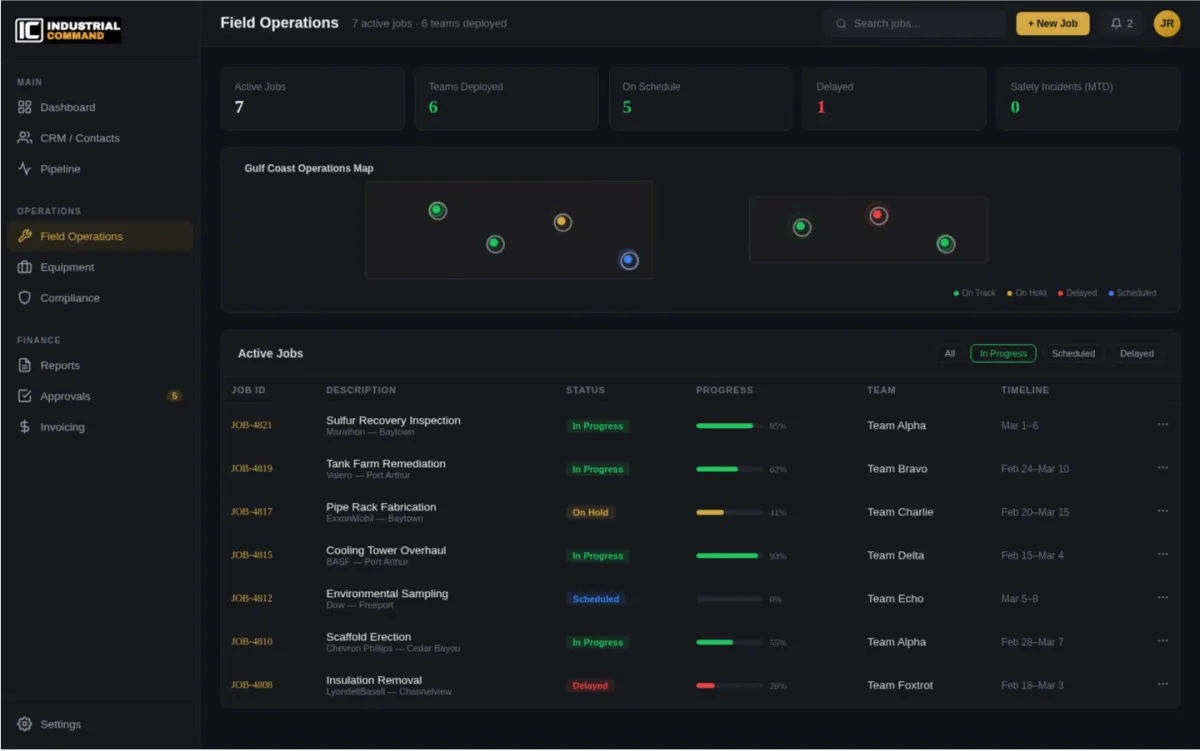
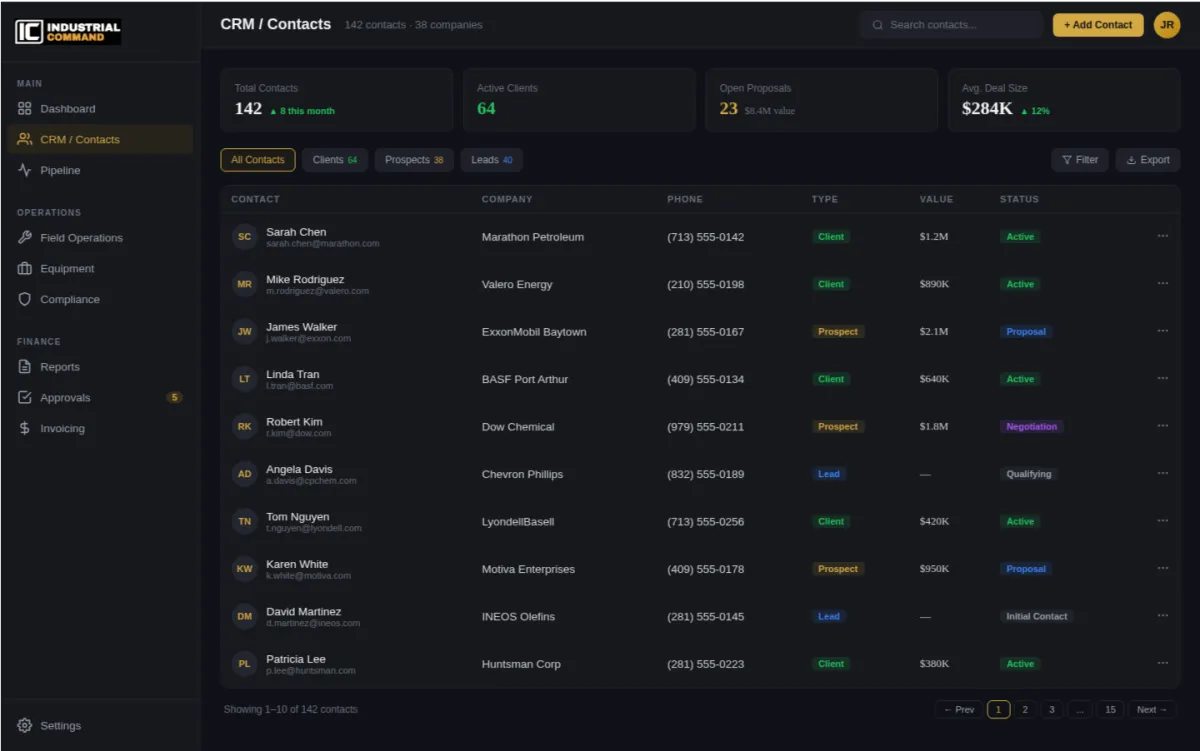
We build custom operational infrastructure that connects:
Field workflows
Equipment & asset oversight
Financial reporting
Sales & estimating
Compliance & environmental tracking
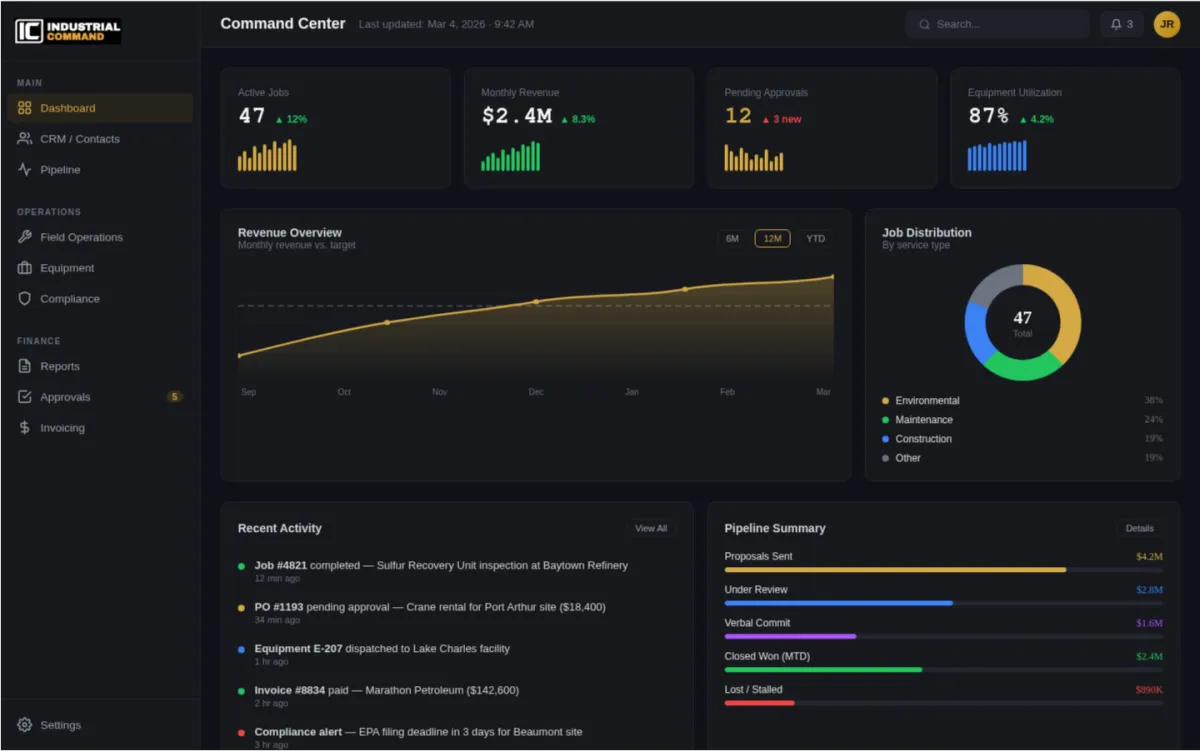
Executive KPI dashboards
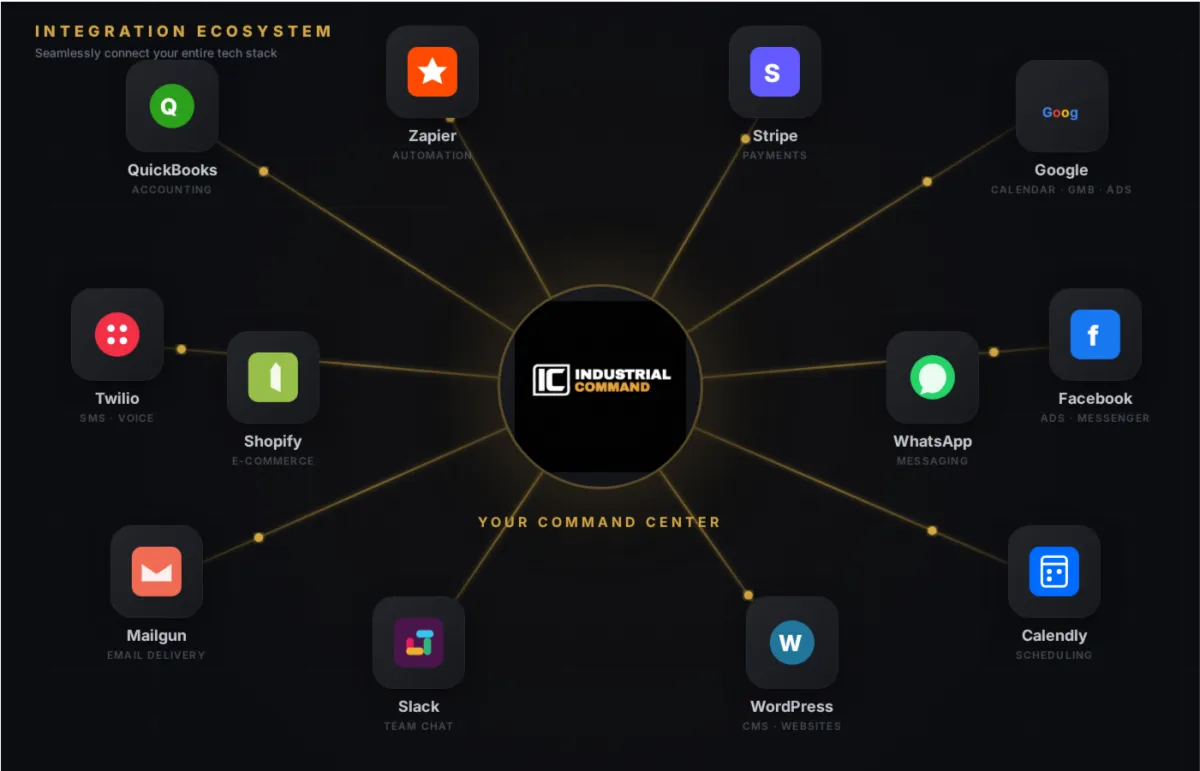
Integrate Your Tools Seamlessly
Our software integrates with your existing tools and platforms to provide a unified experience, ensuring that all your systems work together efficiently.
Enhance Data Accuracy and Reporting
With our automation software, you can automate reporting, data entry, and analysis, ensuring accuracy and real-time insights into your business performance.
OUR PROCESS
From audit to deployment in 60–120 days.
Step 1: Command Assessment
We map your operational workflow from first touch to final invoice.
Step 2: System Architecture
We design a unified operating system around your business model.
Step 3: Automation & Integration
We eliminate bottlenecks and connect your tech stack.
Step 4: Executive Command Dashboard
Real-time visibility across your entire operation.
Step 5: Ongoing Optimization
We operate as your long-term systems partner.
Frequently Asked Questions
What exactly is Industrial Command?
Industrial Command is a custom operating system designed specifically for industrial companies.
We integrate your field operations, approvals, compliance workflows, sales processes, reporting, and leadership dashboards into one unified command layer that is engineered around how your business actually runs.
Is this a CRM or a software subscription?
No, we may integrate CRM functionality, workflow automation, dashboards, and reporting, but Industrial Command is not a generic SaaS tool.
It is a custom operational system designed around your workflows, team structure, and growth goals.
How long does implementation take?
It depends on operational complexity.
Most companies complete:
• Infrastructure Audit: 2–4 weeks
• System Architecture & Build: 4–10 weeks
• Full Deployment: 60–120 days total
We phase implementation to avoid disrupting live operations.
Can you integrate with our existing tools?
Yes. We regularly integrate with:
• Accounting platforms
• Field service software
• Equipment tracking systems
• ERP systems
• Compliance platforms
• Internal databases
If your tools have APIs or export capabilities, we can connect them into your command layer.
What kind of results should we expect?
Clients typically experience:
• Faster approval cycles
• Reduced manual administrative load
• Real-time operational visibility
• Cleaner financial reporting
• Stronger execution discipline
• Reduced compliance risk
Most leadership teams recover 15–25+ hours per week of executive overhead once fully deployed.
Who is this built for?
Industrial Command is built for:
• Owners
• Presidents
• COOs
• Directors of Operations
• Industrial leadership teams
If your company operates yards, warehouses, job sites, plants, fleets, or facilities, this is designed for you.
Is there a minimum company size?
We work best with established industrial companies generating $3M+ in annual revenue, or companies in aggressive growth phases.
The system is designed for operators serious about scaling with control.
What happens after the system is deployed?
We provide ongoing optimization, support, and infrastructure refinement. As your company grows, your operating system evolves with it. We are long-term partners and want to see our clients succeed.
Submit a question if you don't see it here
Not Ready to Build Your Command Center Yet?
Get the Industrial Signals Before Everyone Else
The Southeast Industrial Signal delivers weekly intelligence on rail activity, infrastructure expansion, manufacturing growth, environmental filings, and capital movement so you can move before the market does.